Showing posts with label Oakdale Project. Show all posts

Friday, April 4, 2014

The Patchy, Verdant Gardens of Oakdale

To some degree, everyone is a gardener here, like being a guitarist in a bad.

On the weekends, people congregate outside, each on their own revealing green plots. These verandas vary: some are trimmed finely, planned and lacking any undesirable growth; others betray unyielding browns and pale yellows. In spite of our naturally dry environment, natural growth is hardly considered garden worthy.


All the while, we entertain a neurotic fascination with these mini parks, stoked from without by the scrutinizing eyes of others and impelled from within by a deep yearning to be remarkable.

What is arrayed around the green distinguishes houses. Light flowers, colored pink or purple. Sometimes marigolds, carnations, or lilies even inhabit these sparse, rural installations.

If one is lucky, one might take a stroll by a house with roses; if one is luckier, there will be an bouquet of colors - bold pinks, deep blues, pale yellows, sanguine reds - that suggest fragrances that cannot compare to anything else we might make.

Still, the people here exhibit an odd antipathy toward putting grass to work for rest or respite. It is considered abnormal to use them aside for objects of visual or olfactory delight.

These observations, however, really only hold within the confines of the 'urban' sphere of town, outside of which gardens and flora are all but use. But in town, in town, gardens are all about the aesthetic, the beautiful, the captivating the wonderful, the sublime and the useless.

How 'bout Another, Partner?

Weekends here are spent in many ways, with bar attendance as a strong candidate for most popular, at least amongst a mainly middle-aged crowd.

Like so many of the businesses here, these establishm
ents display themselves proudly and comfortably within the produced (and felt) image of the town as being a cow town, something from which they can themselves derive profit and sustain their own activities on into the future.

Few of these places could be called pubs, and the closest thing to a dive bar here is a warm, friendly joint called, simply "the Cowtrack" (one word, don't get it wrong). Rumors abound about how rough and tumble the different establishments are, but Oakdale is only really so rough and tumble. Increased security might extend this image, but basically Oakdale remains a warm if slightly off-kilter (but not maligned) drunk, that is, in this place without a place.


Protecting Oakdale From Itself

Living in Oakdale means living much living alone: that is, aside from chance encounters between entering and leaving one's car and what happens outside of work contexts (which are themselves restricted to the need to complete certain duties, with little room for play), there is relatively contact with people that are unfamiliar, whose very presence and story is likely very familiar to oneself, the function of habit and routine movement and engagement.

It is this personal distance that serves as the cyclically reinforcing basis for the distrust that pervades this little town.

In my opinion, it is very clearly based on a sense that we are all relatively similar, living in a homogenous community of people with basically the same beliefs such as ourselves that we maintain a sense of distance, of distrust. We assume they are like us, meaning there difference itself is thrust aside entirely, evaded or ignored or deliberately covered.
It is possible, though not certain, that this disposition, however, also caries with it something much darker, more reproachable and even unsettling: the deep disapproval, even ostracization; that is, an unwillingness, a disinterest in engaging with difference in any serious or profound or self-sacrificing manner, preventing us from relating to one another in any serious way, holding even our neighbors in suspicion.

One of my enduring curiosities is whether this kind of marginalization is merely typical of rural settings like this or if it is part and parcel of being human, as we may tend towards our own, preserving and preferring a sense of group identity and community.

A strong distrust of others, in fact, seems essential to any appreciation of the rural, as it originates in the very sense that a previous community has been/was incapable of providing for its members and thus needed to be left behind or replaced. Or, it comes from a longstanding inability to deal with established communities of people and instead prefers to remain in areas undepicted, unrepresented.

In either or whatever case, this way of living calls into question the presumption that being human means living in and coming from a part of some community, or merely qualifies the essential nature of that community.

Or, perhaps, in another way, what it instead signifies is that our community idolizes something possibly inimical to itself - complete and probably under-evidenced self-reliance, an ideology that nevertheless persists and explains our doubts about the ability of the state to make good on the desires of the people.

Such is the state of trust in this place without a place.

Oakdale, You Look Stunning This Evening

For the most part, this place is deficient in stores that relay concerted supplies of clothes or 'modern' apparel. There is such thing here as a Kmart, a beast of a dying breed apparently, and we've so far successfully repelled the vigilant and penetrating gaze of the eye of Walmart. But we have our ubiquitous Walgreens and CVSs, like everywhere else.

The only store more common here than drug stores are dollar stores. We lack several other kinds of arguably necessary establishments, but there is always room for another, nearly identical, establishment that vends questionable items at questionable prices. The sad side to this story is that many of us need these prices, and this town just doesn't provide opportunities for alternatives, and perhaps doesn't want to admit to it, for its own separation into a wealthy (East Oakdale) and less well-supported (West Oakdale).

Stereotypically, there isn't any dearth of, for lack of a better name, "Western Wear." Whole stores are dedicated to its sale and to perpetuating the spectacle of the lone cowboy, not to mention flea markets and even general apparel venders. Owning cowboy boots and some kind of hat is nearly obligatory, even if these purchases are often very costly and should really only be incurred for specific and utility-oriented ends. Then again, this same aesthetically-indulgent trend displays itself in the incessant presence of climate-change-defying (denying) lifted/unlifted trucks that roam this land.

Such is fashion and fare in this place without a place.

Are You Cowboy Enough?

Towns, like salespeople, must promote themselves and their products in a particular way so as to find buyers or to convince unwitting passersby that they themselves should be buyers lest they live hereafter unfulfilled lives.

Oakdale, like so many products (or towns), has its own brand, and this brand is circulated, inserted, announced, presented and reiterated in so many ways over time - in more lasting and ephemeral ways - and this explains the prevalence of the "Cowboy Capital of the World" image that fuels its sense of self.

A brief reference to an aspect of Oakdale's short history is relevant here. Before being the Cowboy Capital and having to vie for the title with a city from another state, the city carried the moniker "The City of Almonds" because, understandably given that the city was surrounded and practically besieged by acres and acres of immense and orderly orchards (as described here), the town should carry a name that fit itself.

At some point, however, the city appeared to decide to absolve itself of any dedication to its real and main commodity and instead develop a different kind of marketing, self-promotional mechanism that may have fit more into external inclinations towards a stereotypical sense of a 'western town.' Although I need substantiate this suspicion more, it is in response to external desires and a need to improve commerce that drove and continues to drive Oakdale to present itself as fitting within a particular discourse of "the West" that emphasizes its affiliation with the lineage of lone, isolated cow-wrangling rough-and-tumble figures. Sure, there is a cattle industry here as well [more figures on its predominance], but it is worth noting that a sense of what makes a town sell becomes its image and even crowds out any more substantive appreciation for what and how it actually is.

Many places are like this: SF draws on certain communities, symbols and images in order to draw tourists and others, and New York and any modern city tied into global flows of capital desire to participate in consumption and commerce (to some extent); but this desire has, in many places, distorted the key formative and identity-determining aspects of a place into participating in tried and already-dominant hegemonic values that interfere with a different kind of development of self.

In fact, it has been telling itself that it is the Cowboy Capital of the World for so long, it has forgotten its own origins, has become caught up in the spectacle, the signs themselves, and forgets what produces them.

Meanwhile, few really consider the offensive implications of basing a town on any such symbol.

Such is the Image that attempts to make a place of this place without place.

As the Water Runs: Irrigation, Canals, and Ponds

Oakdale could not be without its produce, and the fields on and with which this produce is grown are thirsty beyond comparison, necessitating the formulation of an expansive array of water-supplying, water-catching, water-distributing and water-farming systems. These systems are many and complex. They involve well-thought out plans for utilizing water in the most efficient way possible.

In some cases, canals carry water to all of its necessary destinations, and these canals take many forms. Some are well-dug, intentionally-constructed and relatively permanent concrete structures, sometimes taking a prominent V-shape, and angled to ferry its liquid contents from its point of earth-contact to its resting home in the earth once again. Others are less clearly-defined and meander in amorphous, sometimes-curvilinear shapes on their way to deposit their water in the ground. Even other water systems clandestinely supply their beneficial nutrients via underground water-system or more patent drip water systems. There really are too many to count. But what all of these different amphibious equipments suggest is a shared participation in the reality of water as a key resource for these (and all) parts, in one way or the other.

Nearly all of this water originates in the Sierras, our nearest mountain range, where regular (but decreasing snowpack) annually thaws, furnishing (normally) ample supplies of water for any use.

Unlike many surrounding Central Valley areas, Oakdale sits atop a wealth of full, quenching underground reservoirs, and is happily seated adjacent to a quickly running river, the Stanislaus.

But, like many precious resources, water is heavily sought-after, and irritation district official bodies and their representatives carry much power and influence here (not to mention, high pay). This is understandable given that their decisions affect the locals, those who might eventually consume the produce, Bay area residents (who may drink the water or purchase the produce), not to mention so many others unrecognized or ill-accounted for. Such decisions require much time and thought and the seriousness of the issues has, as as of late, engaged many more sectors of the community in political matters than previously, which is probably, on the whole, a positive matter itself.

As getting together to talk about a shared issue, a problem held in common, is never, in-itself, bad practice.

These features of the local environment speak to the reality that water is as important as the thing which seeks to transport it. Without the proper systems, or people to inhabit and operate them, we might be produce-less, parched and even worse, in a place even more rapidly desertifying.


Business is as Busyness Does


Industry in Oakdale is a patchwork of produce and cattle-based agriculture, supported by a sizable service industry and a number of other stores. Their presence provides reason and commerce for the town, even if much of what is actually raised and grown is trucked and bartered elsewhere. Labor in these industries offer the people that inhabit this place with their identity, not to mention a sense for what defines them as denizens of the Central Valley, the "Heartland" of California so to speak.

Formerly, Hershey's populated the town but has since ceded its factory to more modest owners, while lea
ving its own once-prominent Visitor's Center as evidence of its decline and final escape to the South. Nevertheless, the town hasn't soon forgotten its presence, event for the depressing example the Center left: every year during early summer (and about the time when the Cowboys come out), the town holds an event which is now called "Cowboys and Chocolate," containing within itself both the admission of the decay of the city and its ostensible, aspired-for promise of resilience and overcoming even in light of foreboding economic circumstances.

Opposing the unceasing onslaught of mass-produced fast food are a constellation of home-grown cafes and restaurants that play to an array of tastes. They fit into two main categories: those that play to the parodical and self-effacing Cowboy image and 'Mexican food' joints. Although a more thorough and expansive approach is in order to really justify a claim, Oakdale has often been said to have some high-quality, highly-pleasing Mexican cuisine.

But like so many cities, the spectacle of various highly-routinized, highly-franchised fast food restaurants that mass produce commodity-like food abuts many of the other locally-initiated gastronomic endeavors, leaving in their wake failed business after failed business

And while my own proclivities disincline me from partaking, this place as well entertains a number of meat-centric eateries, focused on aggregating, broiling, baking and serving various cuisines that participate in the spectacle of Oakdale as a 'cow'town.


Divinely Electrified Revelation, Oakdale's Church Signs

Religious institutions are a crucial part of the life of this place. Places of worship are routinely visited by lay and devout members of various faiths, and they serve also as necessary sites of social intercourse and generally relaxed engagement.

Churches of all stripes of Christianity reside here but there are so few that might fit outside of this narrow category.

Given their significance to the overall character of the town, the establishments furnish and encourage many of the creative efforts contained within it. Many musicians find their first notes in pious contexts, with, to a lesser extent, participation of artists and writers.

Even more amusingly is how devout comedians (or just lay people with a penchant for witticisms) find their outlet in electrified Church, simultaneously a way for the Church and the author to display themselves while serving as a hopefully-engaging means for increasing future service attendance and participation.

Each display is unique, and they are regularly updated - nearly weekly - with some of the latest in divinely-inspired insights and pithy knowledge. Some are less self-conscious than others, and with a few, you can really see how they provide parishioners with the opportunity for their own chance at comedic or prophetic stardom.

Sometimes the messages they are quirky. Othertimes they are corny. Occasionally they are confusing. But always, they are a sight to see.

And such is the will of God in this place without a place called Oakdale.


Wednesday, March 26, 2014

Moving on Forever: The Orchards of Oakdale


Knowing the rural involves first coming to terms with the noteworthy symbols that make up its circulated spectacle. In popular culture, two of these symbols are the orchard and the pasture, but coming to understand what they might signify and how they differ, not to mention what it feels like to be around and describe them shows how limited such portrayals have so far been.

The orchards, pastures and fields that surround Oakdale are a standing testament both to its profound faith as well as its indefatigable working spirit. These plots are to be found in patchworks in every possible direction, on the outskirts and even very nearby town.

Produce and livestock of all kinds inhabit these places, giving them a checkered, quilted appearance from above. Almond, walnuts, grapes, and a variety of other fruits and vegetables sustain this place (and its agri-coffers), while the warmer weather encourages the cultivation of heat-tolerant plants. Numerous cattle ranches can be founded patterned alongside endless rows of budding or aged and matured trees, the likes of which mirror and emulate the endless of mosaics of Escher. But I think these rows - their neat construction and seeming endlessness - are responsible in part for the enduring Christian sentiments that appear to buoy and anchor this place (and are buoyed and anchored by it).

By this, I mean to say that apparently infinite stretches of road, electricity relay towers, pasture and crop formations imply a kind of eternity in presence and aesthetic that cannot help but utter poems of and prayers from those that live on and around the land (or those that witness it themselves). But this is not to establish cause: just to muse on an odd parallel in their prevailing values.

These patches can be viewed easily enough as long one has a car or a bike (even a tractor); just don't expect to get anywhere quickly, as a parked yellow bus or monstrous trailer might occlude your scenic progress.

 Importantly, orchards and pastures exhibit crucial differences aesthetically and functionally. Orchards are orderly, defined, rigorously planned and plotted rows and columns of trees that cover massive expanses of otherwise uninhabited dirt. Pastures, however, are open fields, the kind for cows or horses to graze on: the sort that unfold to provide sublime views of the world beyond.

Every now and again however, there are stark and beautiful marriages of these distinct geographical features of rurality. One example is pictured here, and special scenes like this one uniquely emerge with the early days (or pre-days) of Spring, heralding its arrival and warning all of its impending showers. The green patches that are found lining and dividing trees are soft and sparse but often appear just as ordered as the trees themselves, instigating us to wonder if they are just young trees aspiring to be like their much older brethren.

Originally, in fact, and as dated photos suggest, Oakdale was the Almond Capital of the World, and while such a moniker is nothing to scoff at, city promoters endeavored for more, finally settling on a much more grandiose (and difficult to substantiate) "Cowboy Capital of the World," which it defended in a brief but noteworthy standoff with a Texas town for the title (decided by and over rodeo ticket sales).

Oakdale would be nothing but for Orchards and Pastures, and these features nourish many local families through the production of countless items of produce and the generation of milk; but even more notably, they provide the means by which we are able to show ourselves in regional, national and international markets. The Central Valley's rural productive apparatus sustains a significant portion of the California economy to say nothing of how Oakdale plays a partial but significant role in this commerce, the way in which these features of land are utilized and deployed, aside completely from their aesthetic presentation and potential.


Saturday, March 22, 2014

On the Road to Town


Oakdale's streets are as diverse as the different kinds of weeds one might fight bordering their paths.

In town, most are well-paved, cared-for and maintained. Newly laid eggshell white paint glares at drivers as their cars speed by, diverting their attention for just a moment's glance. There are exceptions, though; rundown paths line the town the town, and distinguish areas of blight.

Even in the large, top-heavy vehicles that assertively roam this place, one can feel the grit, the holes, the imperfections. No street is immaculate here, just some better at staving off a final judgment of "broken" than others. Woe goes to more public investment in infrastructure.

Outside of town, roads, like many public utilities, have been left derelict. Some more well-tended-to than others, many of them are crumbling, scattering, and in need of attention. They meander in and around an assortment of farms, pastures and meadows, reminding us both of what they are for and the sheer impossibility of any plans of escape for the denizens of this place.

The exception to this rule is the road that enters town from the north and departs it to the west, to the Golden Gate. This foundational tanned trail gives Oakdale one of its raison d'ĂȘtre so to speak. The road curves and winds as it becomes Oakdale, travels along our slow, stalled main streets and escapes again to the wonder of the rolling yellow hills of rural California. 

Roads and paths that puncture, border, criss-cross, grid and set Oakdale also echo a feeling of infinity that similarly characterizes the Orchards and Pastures (fields) that lie on the town's fringes or (sometimes) very near town. Often, towering electrical relays pair with roads and accompany them on their long, seemingly-endless stretch.

These roads give Oakdale is outline - pencil-marks - from which the rest has been colored and filled in.

Sunday, February 9, 2014

Art Blog Introduction Statement: Oakdale Project (aka Reflections On A City Without a Place)

What is in a Place anyways?

It's hard to say what any place is really about, so I'm not even going to try to do that here. I'm just going to leave some of my impressions of a place that I've gotten to know just a little bit too well, and I want to document some of my history with it.

The traces left here are little testament to all that I've experienced and done while living here and really only an introduction to a way of life, in some ways similar to ways of life elsewhere and in some ways distinct and remarkable. I do not purport to say or accomplish much with these transient, experiential ramblings, but I do hope something is 'gotten' or 'learned' or 'appreciated,' if all this means is that you liked the pretty pictures or how I used a verb in a certain way.

Otherwise, I do not have much more to say, aside from: Thanks for Stopping By and...


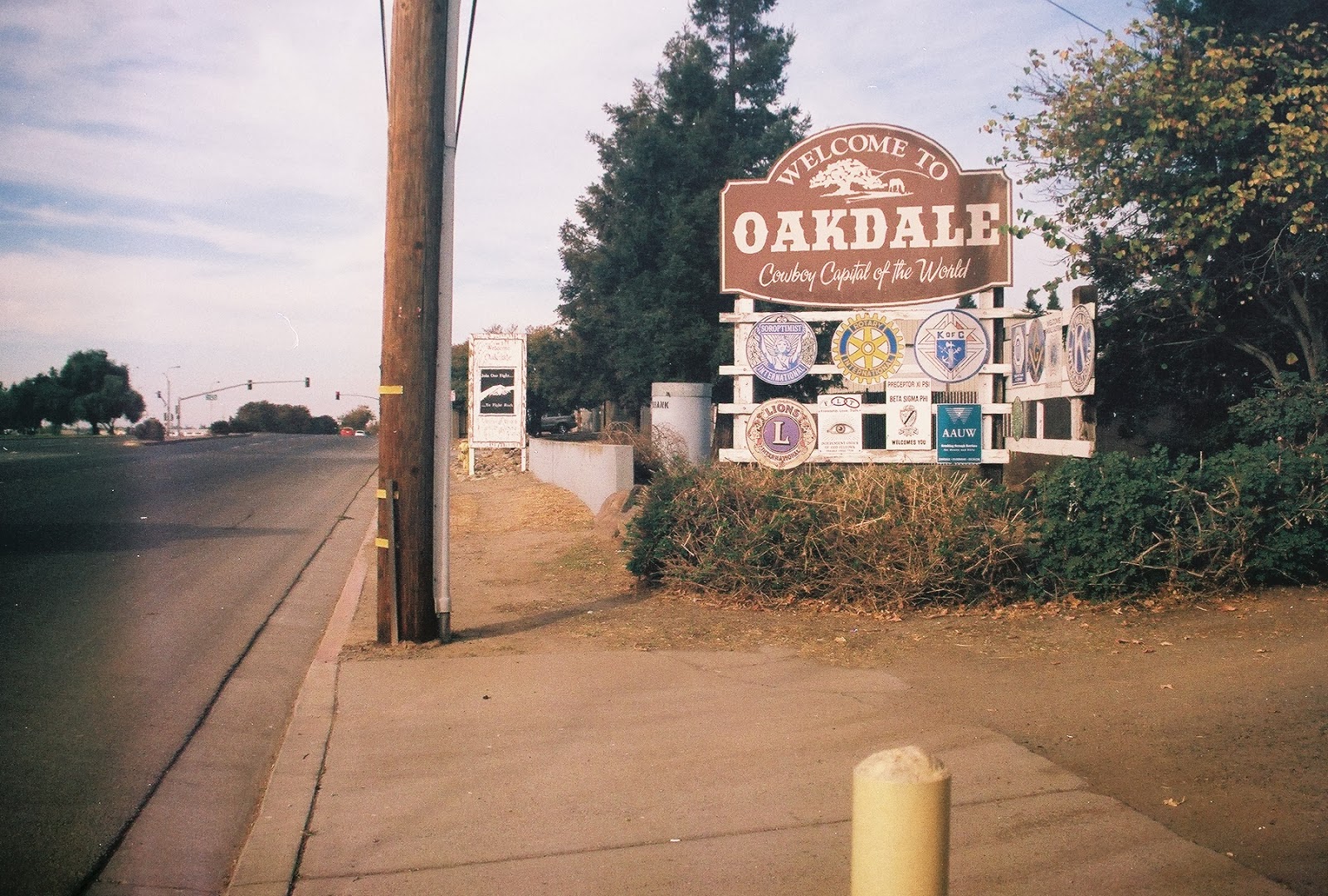
Welcome to Oakdale


(and please do feel free to leave traces of your thoughts, too: those are really what I care about)


The Art of Summer Survival; The Pools of Oakdale

Summers

 Oakdale summers are hot summers; we are not talking eighty to ninety degree warms days punctuating otherwise pleasant, breezy, coastal weather. These are triple-digit summers, the kind we're later proud-to-brag-we-endured summers. Talking about the heat and cautioning others about it- and how we might avoid it - comes to replace 'take care' or 'have a good day.' Instead, we're left with: "stay outta the heat."

These are typically dry times, too, which is supposed to make the climate more bearable. All the same, the offending, imposing heat incinerates any possibility of real interaction with the outside environment. Taking walks involves covering every exposed part of skin, swiftly moving from dark shade-patch to light tree-cover and carrying gallons of water for fear of dehydration.

But it is not as though we actually have to face these treacherous conditions. One can, if they have the privilege of not working in the environment (which so many people do not), just stay inside. And, once done, the rest will too.


Pools

But we like to be outside. To cope, we've institutionalized pool-ing here. Pools serve as an oasis, a recreational opportunity to brave the warm weather, with a relatively certain promise of a cool outlet for these desires.

Pools come in an assortment of shapes, depths, colors, designs, layouts and yard-situations. They are, in a way, the symbol of upper-middle-class success. "We've made it, so let's get a pool."

There are 'doughboys', impermanent pools that sometimes pre-purchasedly inhabit the monstrously immense warehouses of Costco. Doughboys are smaller but a nice compromise, still providing a much needed sanctuary from an otherwise untimely heat-induced fate.

Inset pools have a longer life, and can often reach a greater depth, emanating a sort of religious permanence and a kind of human defiance of the local environmental conditions; it is, as well, a way of bringing and safeguarding water, what is absent, to the home, not even to be consumed but to be leisured in.

Spas and Jacuzzis are mainly nighttime affairs. They play on our bodies ecstatic and comfort-seeking obsession associated with being warmed to a certain temperature. The relax, calming effect of the Jacuzzi simulates that of the Sauna and doesn't require the same level of investment. It is also, status-wise, how one moves from solely having pool; that is, having the ability both to cool on warm days and to warm on cool nights.

Insulating its parishioners from the actual state of the local climate is as much part of enjoying pools as is any recreational activity facilitated by their presence, and the presence of water. It also seems to remind us of a primordial relationship with the stuff that we will never be able to escape, as much property values and urban flight encourage it.


Rivers and Reservoirs

In addition to constructed pools, there are numerous rivers, creeks, reservoirs, and 'naturally'-occurring bodies of flowing or still water. They are to be found both in town and outside of it, and if you move further away, you might even find a dam or two.

These might weave in and around roads or border long expanses of fields and orchards. Often, they are drawn from for irrigation purposes.

It is also widely known that Oakdale survives and thrives largely on the presence of an underground reservoir of clean, flowing water, without which, we might be be in the same situation in which unknowingly citizens of LA or San Francisco find themselves: up a creek (but really, just dependent on more hinter-landing batteries of thirst-quenching water).

Note: I've included a few photos here, but more will follow

Rain, Rain (Please don't) Go Away: Come Again Another Day

Rain in Oakdale brings a new and different kind of reassuring, if unanticipated calm, and especially now. For some time, California has been experiencing routine and persistent droughts, as if someone on high is holding out on us.

This issue, while an inconvenience to many, is felt all the more acutely in places like Oakdale, where industry is primarily agricultural, and our very subsistence, not to mention general economic improvement largely rests on a key variable over which we have no control.

If there is no rain, there is no Oakdale: the grass would permanently yellow, crops would wilt and perish, and animals would thirst.

Many who live in town are nevertheless often caught unprepared and the normal sartorial precautions one might expect to witness elsewhere are not even given a second thought (as if it were an affront to our sense of personal survivability to actually outfit ourselves in appropriate ways).

Nevertheless, we press on, while the rainclouds pour and the streets fill, patently surprised at the presence of a thing that they are incapable of swallowing: somehow we make it through.

Many are annoyed, but those of us who are doomed to be kids at heart no matter what our age still take pleasure in pushing headlong in pooled bodies of parking-lot street water, lamenting its inevitable dissipation by the unfun gods of City Park and Rec.


Friday, October 25, 2013

Letter to the Editor on "The Park People"

Dear Oakdale,


Having returned recently from a scholarly stint in the bay, I was dismayed to find uprooted public benches, probing Leader articles, impassioned public debate, and a regrettable disdain for the “park people.” To my chagrin, I felt this personally while walking to Cafe Bliss, when I was curtly accosted by nearby store owner who interrogated meanly: “Are you one of those park people?”


I worry that the recent ordinance that diagnoses the issue as alcoholism is only the most recent contribution to the city-wide discourse about the ‘park people’ that has yielded unhealthy discussions about ‘who they are’, these members of our community. It also ignores many of the contributing factors to the development of such a habit, including but not limited to poverty, which is not an individual but a shared, social issue. This ordinance that endeavors to address the issue simplifies the atmosphere of causes and effects and generates a solution that addresses only a small part.


I want us to come to an effective solution like the rest of you. But labeling a complex and multifaceted issue of poverty, social stigmatization, and the rapid disappearance of the public space as one of ‘public drunkenness’ is misleadingly simplistic and infused with failed, outdated prohibitionist values. While treating a loose group of park-goers as “those people” does little more than create unnecessary fissures in our own community. The issue is far from resolved, so let us focus on creating inventive, inclusive solutions, such as shelters, or simply those that treat these ‘people’ as human beings in order to actually be that loving, inclusive Oakdale we purport to be.

(In my search for city council minutes, I also found it quite challenging to obtain a copy, anything after 2012,, which signals a possible but remediable barrier to public knowledge.)